Friday, 27 March 2015

How to make your own breakfast cereal with carob syrup


The Carob tree or Locust tree is an evergreen plant, belonging to the pea family, which is native to the Mediterranean region. It tends to grow in warm climates and may live hundreds of years.  Thus the trees should be protected and respected. The bean-shaped pods naturally contain polyphenols, which help lower blood cholesterol levels if consumed regularly.  These polyphenols also act as powerful antioxidants, protecting your body from the damage of free radicals. These nutrients are found in the seeds as well as in the flesh of the pods.

Carob has been consumed since ancient times as mentioned in the Bible and other texts. It has traditionally been used as an expectorant in the treatment of coughs, in the form of sweets and drinks.

With the following recipe you will be able to make cereal bars to last a few days, with a quick and simple no-bake method and a few inexpensive ingredients. The most important thing is that you will know exactly what went into your snacks. These are ideal for breakfast too.


Recipe:

1/3 cup milk
½ cup carob syrup
2 tablespoons Maltese honey
½ cup peanut butter
1 teaspoon vanilla essence
2 ½ - 3 cups rolled oats


In a sauce pan mix the milk, carob syrup and honey together and bring to the boil, stirring constantly. Remove from the heat after boiling for 3 minutes.  Add the peanut butter and vanilla essence and mix thoroughly. Finally add the rolled oats a little at a time, until you have a paste that can be moulded into shape.


Use a greased 20 x 20 cm dish and press the mixture into shape. Refrigerate for a few hours or overnight. Cut into shape or crumble to use as cereal with milk or yoghurt.

Tips:
Preferably choose a peanut butter that contains 90-100% peanuts and some salt and no hydrogenated oils or added sugar. You might want to add some more honey to make the texture stickier to form cereal bars.

Merill products used: carob syrup (ġulepp tal ħarrub) and local honey


Wednesday, 25 March 2015

Bird is the Word!

Chicken meat is a lean, versatile and affordable means of getting protein. And yet not all chicken is equal. In Malta, St. Mary Farm has been operational for 23 years and Karl took over in 2011, soon after he obtained a Diploma from MCAST. Karl is the youngest member of the Merill Rural Network and he proudly describes the conditions under which the broilers – chickens of a special breed kept purposely for meat consumptions – are kept. 
Their sanitation and health is taken seriously. For example, their feed is studied well so that it fulfills all their nutritional needs; the temperature of the pens is controlled to keep them at their healthiest and happiest. There are less chickens per squared meter when compared to other EU countries because their rearing is less intense. In Malta, all barns are regularly tested for Salmonella and very strict sanitation rules are followed. 


This means that you can feel safe buying local chicken for your family’s consumption. By doing that you would be supporting a local farmer and decreasing the carbon footprint of your meals. 
The Recipe:
  • Heat your fan-assisted oven to 200 degrees Celsius and cook the chicken thighs for 12 minutes on each side. 
  • With a brush, spread the tomato jam on both sides and return to the oven to cook for a further 5 minutes on each side. Remember that the appearance of the chicken flesh is not always enough to judge whether it has cooked through and is safe to eat. 
  • Use a meat thermometer to check that the internal temperature has reached 73 degrees Celsius (165 Fahrenheit) and make sure that any juices that come out of the chicken run clear. The tomato jam will form a coating on the meat that will give it an interesting tangy and sweet flavor with an attractive appearance. Just a simple addition to your usual roast chicken will make a big difference to the result you present to the table.

Serving suggestion:
  • Sweet potato chips: Peel a sweet potato and cut it into strips. Drizzle some olive oil and sea salt on top and roast in the oven whilst the chicken is cooking (in a different dish). Toss every few minutes to make sure all your chips cook evenly and remove them from the oven when they are cooked through and start to brown at the edges. Depending on the size of your chips, they should take between 20-30 minutes to cook at 200 degrees Celsius.
  • Simple side salad: Use vegetables that are eaten raw such as tomatoes, cucumber and bells peppers. Chop into bite size pieces and drizzle with olive oil, sea salt and freshly ground black pepper to taste. You may also crumble a fresh, local cheeselet (Ġbejna) on top.

Merill products used: tomato jam, extra virgin olive oil, sea salt, and a ġbejna.


Tuesday, 17 March 2015

Why local?


Fresh local bread


It’s one of those phrases we hear all the time and yet if we were to dig deeper, do we know exactly why we should eat local produce? A few of the answers are more obvious – we like to support small businesses and the image of a genuine, ‘homemade’ or ‘home-grown’ product attracts us; but is there more to this? 


Why opt for local?

  1. Local foods are fresher (and taste better)
  2. Local foods are seasonal (and taste better!)
  3. Local foods usually have less environmental impact
  4. Buying local foods helps preserve green areas and farmland on our islands
  5. Local foods promote food safety
  6. You will be supporting the local economy
  7. You create a stronger community
  8. You will help to promote variety

Fruit, vegetables and meat that aren’t sourced locally have to be shipped from around the world to get to you. In the case of fruit and vegetables, these are usually picked before the peak of their flavor in order to survive the long trip (or be allowed to mature while they travel) to your local grocery store. As a result, the carbon footprint is higher.


Brussel sprouts

  It may seem like common sense, but it's one of those things many of us ignore when we're shopping. This concept doesn’t just stop at fresh produce; the processing of local raw foods into jams and preserves should be considered too.  Transporting produce sometimes requires irradiation and preservatives (such as wax) to protect the produce which is subsequently refrigerated during the trip. All of these elements will decrease the nutrient content of your fruits and vegetables.


When local farmers and live breeders experience increased demand and hence more economic support, they are encouraged to keep more types of produce and livestock.  Eating in season is also a good idea if you’re aiming to spend less money and get more nutrients; following the course of nature as seasons change will also encourage you to expand your palate and keep eating a wide variety of different foods all year round.


Traditional bread with local ingredients

The Merill Rural Network is committed to supporting farmers and to using recyclable and reusable materials for packaging, thus through buying local products we are perpetuating the reduction of our carbon footprint at the same time. The network brings together farmers and artisans to create authentic products and thanks to this opportunity many of them are able to invest further in their business. Thus this initiative helps Maltese farmers and livestock breeders to continue offering a genuine product that is the fruit of our island’s soil, nutrients, water and sun. The wheel keeps on turning and at the end of the day we will benefit from such an investment too!
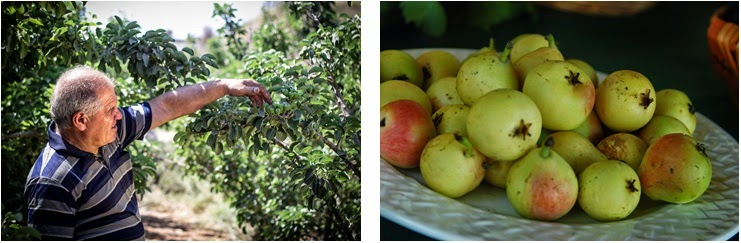
Take the bambinella (Pyruscommunisvar. bambinellaL. from the family Rosaceae) for example, an indigenous fruit otherwise known as the Small Malta June Pear. This crisp mini-pear with an attractive pink/red-blushed skin grows between the months of July to September, depending on the variety and the location of the field. Since its growth and ripening depends highly on the water content and hours of sunshine per day, the fields that have darker and thus warmer soils will be more successful in ripening the fruit. The fruit may be small but it is mighty – the bambinella has a long shelf life and is thus considered a very convenient one. Besides, the fruit is delicious and sweet and very handy for carrying around as a snack.
Mario Scerri, a farmer from Dingli at Ta' Zuta Orchard.


By supporting local products and hence biodiversity we are decreasing the chance of losing such products that may be unique to our islands and we are being kind to ourselves in the process.


Would you like to know more about our Merill Local Products? Drop us a line on info@merill.com.mt


Tuesday, 9 December 2014

Christmas Hampers... Do you just want to impress?

When you're choosing a gift for a corporate partner or a special friend, would you just be interested in getting the task off your to-do list? Or would you much rather look good AND feel good at the same time? If yes, read on… 

It all started exactly 5 years ago, when Jeanette (my wife and now also partner in business… quite brave isn't it?) and I were waiting to obtain all our permits and licenses in order to start offering innovative eco and agri tours! 

We were in for a couple of surprises and a very long wait, so to make ends meet, we came up with the idea of Eco-Hampers. We were venturing into ecotourism, so it seemed only natural to think 'eco', and Christmas-time was fast approaching - so these little (and not so little) gifts in rustic upcycled boxes were born. 

some of the very first jars prepared as 
souvenirs for the official launch of Merill
Looking back at our first campaign in November 2010, I can proudly say that we've come quite a long way; not only did we keep our core values at the centre of our business model, but today we consolidated the venture into a unique Rural Network which greatly values the products of hard-working Maltese and Gozitan farmers, artisans and their families.

Our products are not industrial. Far from it. There may be times when they are very limited or not available at all; and they are definitely not the cheapest around. However we make sure that they are the best products that our little sunny islands are able to offer, and that the members within the network get more than a fair share for their toils. 

On each and every label of our products, we list the name of the farmer or artisan producing the item, together with the location from where it originates, so that we make it easier for our customers to ask for specific products.

If you would like to get to know more about the network and our Eco-Hampers please click on this link http://bit.ly/1zYqJxG, and should you want to take it a step further, visit us at our Merill Speciality Store in Qormi,  and we'll be able to treat you to a cup of traditional coffee. Here's a map which shows you how to find us http://bit.ly/1vRaDVz!

All the very best

Christian & Jeanette


Press coverage for Merill's launch January 2011


info@merill.com.mt              21 / 27 / 79 411388

Monday, 27 October 2014

Merill Eco Hampers - 5th year exclusive collection


_______________________________________________


_______________________________________________


_______________________________________________


_______________________________________________


_______________________________________________


_______________________________________________


_______________________________________________


The
Merill
Rural
Network


WHY?
Because we really want to make a difference.

WHERE?
We pride ourselves to offer products that are exclusively from the Maltese Islands.

HOW?
Local farmers and artisans are empowered to produce genuine local products of premium quality. This way we enable them to sustain generations of traditions.

WHO?
The Merill Rural Network brings together a number of hard working farmers and artisans. Along with their families they passionately maintain our landscape, while providing us with delicacies and handmade works of art.


_______________________________________________

Other options available. We can offer delicacy items as well as artisanal handmade gifts such as weaving, filigree and pottery.


For more information email us on info@merill.com.mt or visit our Speciality Store at 75, Triq San Bartolomew, Qormi to prepare your own Eco Hamper.

21 411 388 | 27 411 388

Prices include 18% VAT